Blue Foundation
This week NASA officially requested the United States house business to dish the main points on its plans for short spaceflights. In essence, the gap company mentioned it desires to shop for rides for its astronaut corps and scientists for short hops into house however wishes additional info.
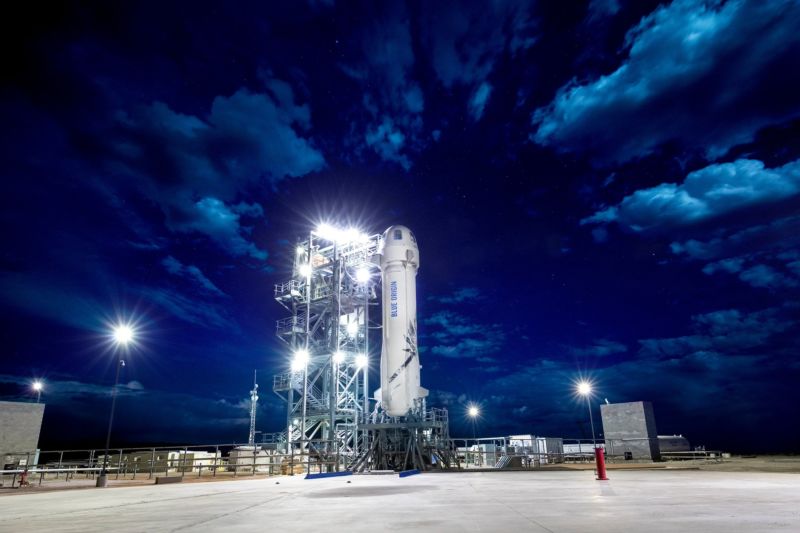
The company used to be intentionally obscure in its solicitation for “suborbital workforce transportation products and services.” In a dialogue with journalists, the brand new program supervisor, Scott Colloredo, mentioned, “We truly wish to listen what business has to let us know.” He indicated that the solicitation used to be extensive open, with NASA looking for enter from established firms corresponding to Blue Foundation and Virgin Galactic, to firms corresponding to Area Standpoint that wish to take other folks a couple of dozen kilometers above the Earth’s floor.
Alternatively, in an interview with Ars, NASA Administrator Jim Bridenstine mentioned this system seeks most commonly to extend the time NASA spends in microgravity. “What we’re looking to do is supply get admission to to a useful resource that traditionally has been very restricted,” he mentioned.
NASA has drop towers the place experiments can get admission to a few seconds of microgravity. All the way through a 0-G flight, people and medical analysis revel in weightlessness in 20-second increments. Those are secure and feature decrease prices. At the different finish of the spectrum, thru Group Dragon, NASA astronauts can revel in months of microgravity at a price of greater than $50 million according to seat and better publicity to dangers.
Discovering a candy spot
Bridenstine mentioned NASA wish to to find someplace in between the place there are most likely five to 10 mins of uninterrupted microgravity. With this period of time, astronauts would possibly go through coaching, scientists may just have a tendency to experiments, and engineers may just qualify flight .
The timing of the solicitation comes as each Blue Foundation, with its New Shepard gadget, and Virgin Galactic, with its VSS Cohesion spacecraft, seem to be inside of a yr or much less of starting business operations. Despite the fact that the firms have other programs—New Shepard provides a standard release, while VSS Cohesion is a rocket-powered house airplane—they each are designed to offer a number of mins of weightlessness.
NASA has a bunch in thoughts, with regards to price range, that it desires to pay for those products and services. However Bridenstine mentioned the company is looking business for comments first to get a way of what inner most suppliers predict to rate. For the general public, Virgin Galactic has bought person tickets for $250,000. Blue Foundation has now not set a public worth, despite the fact that it’s prone to be upper than this according to seat.
Possibly the most important query about this system is the danger that NASA is prepared to simply accept in placing its other folks on those house cars. For the gap go back and forth program, NASA had whole oversight of the automobile’s building. Despite the fact that the economic workforce program used to be a public-private partnership, NASA nonetheless had important perception into each aspect of SpaceX’s Group Dragon and Boeing’s Starliner spacecraft as it paid for lots of the building prices.
Balancing value and chance
Now that NASA is making an attempt to be actually only a buyer, how will the company steadiness that chance? Bridenstine mentioned he expects to measure protection, in part, by way of flight revel in. “It’s one thing that we’re going to need to paintings thru as an company,” he mentioned. “By the point NASA flies on those suborbital business cars they’re going to have already flown a large number of occasions. They are going to now not be untested cars. NASA has an extended historical past of the use of flight revel in as a substitute for qualifying and certifying each sub-component.”
All of the identical, NASA does ask for detailed protection details about the cars in its solicitation. Particularly, it seeks information on “fracture keep an eye on and fault tolerance,” indicating a want to have a basic working out of the construction and margin of those spaceflight programs.
Based totally upon its general report, the gap go back and forth had a loss-of-crew likelihood of about 1 in 70. Despite the fact that the economic workforce program is simply getting began, NASA required the ones cars to be designed to a loss-of-crew likelihood of one in 270. Requested what same old NASA would cling the suborbital cars to, Bridenstine mentioned NASA has now not established a stringent price.
Alternatively, he mentioned, the likelihood could be “considerably” not up to each the go back and forth and business workforce. “We’re now not going to make it extra unhealthy than orbital flight,” he mentioned of suborbital flight.
Managing dangers with out considerably expanding prices would seem to be a troublesome balancing act for NASA relating to New Shepard and VSS Cohesion. Alternatively, the truth that two privately funded suborbital release programs are nearing a state of adulthood seems to validate NASA’s way of looking to develop into one of the consumers in spaceflight, reasonably than the only buyer of a pricey release gadget.


