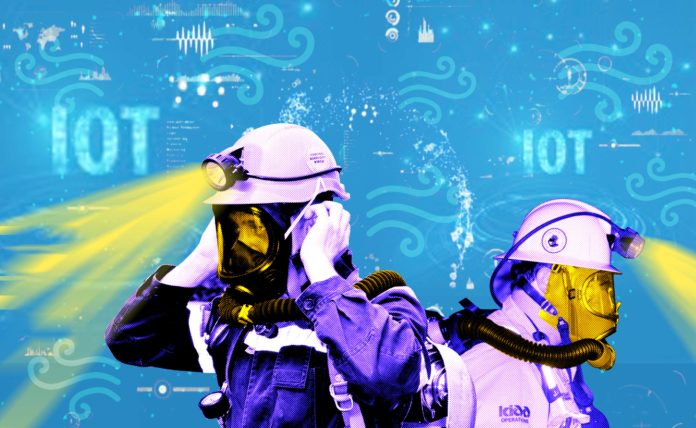
Underground mines are massive business operations and high for IoT adoption, particularly the place protection is worried. Mines are incessantly in far flung geographic places. Whilst an open-pit mine, even a big one, may also be inspected via drones and different simple strategies, underground mines are darkish, complicated, and constrained, with layouts that vary as ore our bodies are exhausted and new ones are exploited. The surroundings is incessantly scorching, dusty, and filled with vibration, decreasing the efficient lifetime of tracking and communications apparatus.
Because of this, mining is bad. Equipment is big, visibility incessantly deficient, and maneuvering tight. And employees face threat from pooling poisonous gasses and airborne particulates, which is able to each kill briefly and purpose long-term lung injury.
Offering a protected operating surroundings for miners is a key industry precedence for the trade and one the place IoT implementations are proving their usefulness. Nonetheless, the penetration of IoT in mining is proscribed.
Is Mining Inherently a Technologically Conservative Industry?
Mining is massively capital extensive, dangerous, and unsafe. It calls for operations in far flung, tough places. And it’s on the mercy of fluctuating commodity costs (iron ore has swung between $40 and $120 a metric ton simply within the final 3 years), making long-term funding tough.
Underneath those stipulations, it may be tough to justify investments in new applied sciences. Andrew Shook, in AusIMM Bulletin, has mentioned quite a lot of the explanation why innovation is tricky on this trade, together with how commissioning issues in new applied sciences can do critical injury to the economics of a mining venture. Each extremely winning and unprofitable mines have hassle justifying new funding, and it’s nonetheless tough to grasp what lies within the rock being dug into.
Whilst many industries face a disjuncture between data generation (IT) and operational generation (OT), mining arguably has the biggest IT/OT hole. This hole happens between algorithms advanced in air-conditioned workplaces and the noisy and threatening operational surroundings of a mine, transferring lots of rock in pursuit of the fraction of an oz of helpful steel hidden in it.
The in all probability routes for IoT penetration are protection and compliance, in addition to for apparatus tracking and upkeep. Poisonous fuel tracking is any other house the place IoT can reveal worth.
Air flow and Toxicity
A big attention in underground mining is offering employees with blank, non-toxic air that incorporates enough oxygen. Noxious gases, a few of them explosive in addition to poisonous, at the side of blasting operations, are the most typical reasons of mining injuries, each deadly and nonfatal. Particulates, each from rock and ore and within the type of diesel particulate topic (DPM), also are an important well being possibility underground.
Those gases come with carbon dioxide, carbon monoxide, hydrogen, hydrogen sulfide, methane, nitrogen, nitrogen dioxide, and sulfur dioxide. And whilst oxygen isn’t poisonous, an extra focus of it will possibly dangerously boost up combustion, making the surroundings bad in different ways.
Speedy toxicity is essentially the most salient worry, however long-term publicity to sublethal doses of poisonous gasses and particulates, even those who appear to have no impact, can adversely impact employee well being. Such gases as radon, the ones in welding fumes, and mercury may have important detrimental long-term results.
Ways and Strategies
A key to air flow and toxicity control is tracking and examining airflow. Then, we will determine the right way to beef up it and save you apparatus failure that would purpose airflow to drop beneath appropriate ranges.
Wearables will increasingly more play a task. They are able to additionally come with poisonous fuel sensors, however extra importantly, display employee location in terms of spaces of low oxygen or top poisonous focus. It may be extraordinarily tough to grasp the place everyone seems to be in a mine, or even skilled employees can get disoriented and misunderstand the place they’re at a given second.
When mine supervisors know each the place each employee and automobile is and what the ambient ranges of poisonous gasses and particulates are and the way they modify through the years, they may be able to make certain that air provide is perfect for occupied spaces, whilst reducing air flow to spaces no longer lately running. Along with expanding protection, this ends up in a considerable saving in energy and upkeep prices.
Conclusion
IoT, in lots of respects, generally is a unusually tricky promote to mining operations suspicious of recent generation, however it will possibly briefly display its application in making improvements to employee protection, expanding the visibility of all mine operations, and enabling simpler compliance reporting. Specifically, IoT can give explicit advantages in air flow and air high quality.


