
Aurich Lawson / Getty
Greater than 100,000 folks were inflamed with a brand new coronavirus that has unfold broadly from its beginning in China during the last few months. Greater than three,000 have already died. Our complete information for working out and navigating this world public well being risk is under.
This can be a hastily creating epidemic, and we will be able to replace this information ceaselessly to stay you as ready and knowledgeable as imaginable.
March eight: Preliminary e-newsletter of the file.
Desk of Contents
How frightened will have to I be?
You will have to be involved and take this severely. However you will have to now not panic.
That is the chant public well being professionals have followed because the epidemic mushroomed in January—and it’s about as comforting as it’s simple to perform. But it surely’s essential that all of us check out.
This new coronavirus—dubbed SARS-CoV-2—is for sure unhealthy. It reasons a illness known as COVID-19, which may also be fatal, specifically for older folks and the ones with underlying well being prerequisites. Whilst the dying price amongst inflamed folks is unclear, even some present low estimates are seven-fold upper than the estimate for seasonal influenza.
And SARS-CoV-2 is right here in the USA, and it is circulating—we’re most effective beginning to decide the place it’s and the way a long way it has unfold. Issues of federal checking out have not on time our skill to discover infections in vacationers. And as we paintings to catch up, the virus has stored shifting. It now seems to be spreading in different communities around the nation. It’s unclear if we can get forward of it and comprise it; even though we will be able to, it’ll take a large number of sources and energy to do it.
All that stated, SARS-CoV-2 isn’t an existential risk. Whilst it may be fatal, round 80 % of instances are gentle to reasonable, and folks get better inside every week or two. Additionally, there are glaring, evidence-based movements we will be able to take to offer protection to ourselves, our family members, and our communities general.
Now isn’t the time for panic, which can most effective get in the best way of what you want to be doing. Whilst it’s utterly comprehensible to be frightened, your very best wager to getting via this unscathed is to channel that nervous power into doing what you’ll to forestall SARS-COV-2 from spreading.
And to do this, you first want to have probably the most entire, correct knowledge at the scenario as you’ll. To that finish, under is our very best try to deal with all the questions you could have about SARS-CoV-2, COVID-19, and the location in the USA.
We’ll get started with the place all of this begins—the virus itself.
What’s SARS-CoV-2?
SARS-CoV-2 stands for critical acute respiration syndrome coronavirus 2. Because the title suggests, it’s a coronavirus and is said to the coronavirus that reasons SARS (Critical Acute Respiration Syndrome). Be aware: When SARS-CoV-2 used to be first recognized it used to be provisionally dubbed 2019 novel coronavirus, or 2019-nCoV.
Coronaviruses are a big circle of relatives of viruses that get their title from the halo of spiked proteins that decorate their outer floor, which resemble a crown (corona) below a microscope. As a circle of relatives, they infect quite a lot of animals, together with people.
With the invention of SARS-CoV-2, there at the moment are seven sorts of coronaviruses identified to contaminate people. 4 ceaselessly flow into in people and most commonly reason gentle to reasonable upper-respiratory tract infections—not unusual colds, necessarily.
The opposite 3 are coronaviruses that just lately jumped from animal hosts to people, leading to extra critical illness. Those come with SARS-CoV-2 in addition to MERS-CoV, which reasons Center East Respiration Syndrome (MERS), and SARS-CoV, which reasons SARS.
In all 3 of those instances, the viruses are idea to have moved from bats—that have a lot of coronavirus lines circulating—to people by the use of an intermediate animal host. Researchers have connected SARS-CoV to viruses in bats, which will have moved to people via masked palm civets and raccoon canine offered for meals in live-animal boulevard markets in China. MERS is assumed to have unfold from bats to dromedary camels earlier than leaping to people.
The place did SARS-CoV-2 come from?
SARS-CoV-2 is said to coronaviruses in bats, however its intermediate animal host and path to people don’t seem to be but transparent. There was numerous hypothesis that the intermediate host might be pangolins, however that’s not proven.
How did it get started infecting folks?
Whilst the identification of SARS-CoV-2’s intermediate host stays unknown, researchers suspect the thriller animal used to be found in a reside animal marketplace in Wuhan, China—the capital town of China’s central Hubei Province and the epicenter of the outbreak. The marketplace, which used to be later described in Chinese language state media reviews as “filthy and messy,” offered quite a lot of seafood and reside animals, some wild. Most of the preliminary SARS-CoV-2 infections had been connected to the marketplace; in truth, many early instances had been in individuals who labored there.
Public well being professionals suspect that the untidiness of the marketplace will have ended in the virus’ unfold. Such markets are infamous for serving to to release new infectious sicknesses—they generally tend to cram people along with numerous reside animals that experience their very own menageries of pathogens. Shut quarters, meat preparation, and deficient hygienic prerequisites all be offering viruses an inordinate collection of alternatives to recombine, mutate, and soar to new hosts, together with people
That stated, a file in The Lancet describing 41 early instances within the outbreak signifies that the earliest recognized particular person sickened with SARS-CoV-2 had no hyperlinks to the marketplace. As Ars has reported earlier than, the case used to be in a person whose an infection started inflicting signs on December 1, 2019. Not one of the guy’s circle of relatives was in poor health, and he had no ties to any of the opposite instances within the outbreak.
The importance of this and without equal supply of the outbreak stay unknown.
The marketplace used to be close down and cleand through Chinese language officers on January 1 because the outbreak started to pick out up.
What occurs whilst you’re inflamed with SARS-CoV-2?
In folks, SARS-CoV-2 reasons a illness dubbed COVID-19 through the Global Well being Group (WHO). As the USA Facilities for Illness Regulate and Prevention (CDC) issues out, the ‘CO’ stands for ‘corona,’ ‘VI’ for ‘virus,’ and ‘D’ for illness.
What are the indicators?
COVID-19 is a illness with a variety of signs and severities, and we’re nonetheless finding out in regards to the complete spectrum. Up to now, it sort of feels to span from gentle or probably asymptomatic instances all of the option to reasonable pneumonia, critical pneumonia, respiration misery, organ failure and, for some, dying.
Many instances get started out with fever, fatigue and delicate respiration signs, like a dry cough. Maximum instances don’t get a lot worse, however some do growth into a significant sickness.
In line with knowledge from just about 56,000 laboratory-confirmed COVID-19 sufferers in China, the rundown of not unusual signs went as follows:
- 88 % had a fever
- 68 % had a dry cough
- 38 % had fatigue
- 33 % coughed up phlegm
- 19 % had shortness of breath
- 15 % had joint or muscle ache
- 14 % had a sore throat
- 14 % headache
- 11 % had chills
- five % had nausea or vomiting
- five % had nasal congestion
- four % had diarrhea
- Not up to one % coughed up blood or blood-stained mucus
- Not up to one % had watery eyes
That knowledge used to be printed in a file through a band of global well being professionals assembled through the WHO and Chinese language officers (known as the WHO-China Joint challenge), who toured the rustic for a couple of weeks in February to evaluate the outbreak and reaction efforts.
How critical is the an infection?
The general public inflamed may have a light sickness and get better utterly in two weeks.
In an epidemiological learn about of 44,672 proven instances in China, authored through an emergency reaction crew of epidemiologists and printed through the Chinese language CDC, researchers reported that about 81 % of instances had been thought to be gentle. The researchers outlined gentle instances as the ones starting from the slightest signs to gentle pneumonia. Not one of the gentle instances had been deadly; all recovered.
Of the rest instances within the learn about, about 14 % had been thought to be critical, which used to be outlined as instances with tough or worked respiring, an greater price of respiring, and reduced blood oxygen ranges. Not one of the critical instances had been deadly; all recovered.
Just about five % of instances had been thought to be important. Those instances incorporated respiration failure, septic surprise, and/or a couple of organ disorder or failure. About part of those sufferers died.
In spite of everything, 257 instances (zero.6 %) lacked severity knowledge.
The total fatality price within the sufferers tested used to be 2.three %.
Who’s maximum prone to getting severely in poor health and loss of life?
Your chance of changing into significantly in poor health and loss of life will increase with age and underlying well being prerequisites.
Within the staff of 44,672 instances mentioned above, the best fatality charges had been amongst the ones elderly 60 and above. Other people elderly 60 to 69 had a fatality price of three.6 %. The 70 to 79 age staff had a fatality price of about eight %, and the ones 80 or older had a fatality price of just about 15 %.
Moreover, the researchers had details about different well being prerequisites for 20,812 of the 44,672 sufferers. Of the ones with further scientific knowledge to be had, 15,536 stated that they had no underlying well being prerequisites. The fatality price amongst that staff used to be zero.nine %.
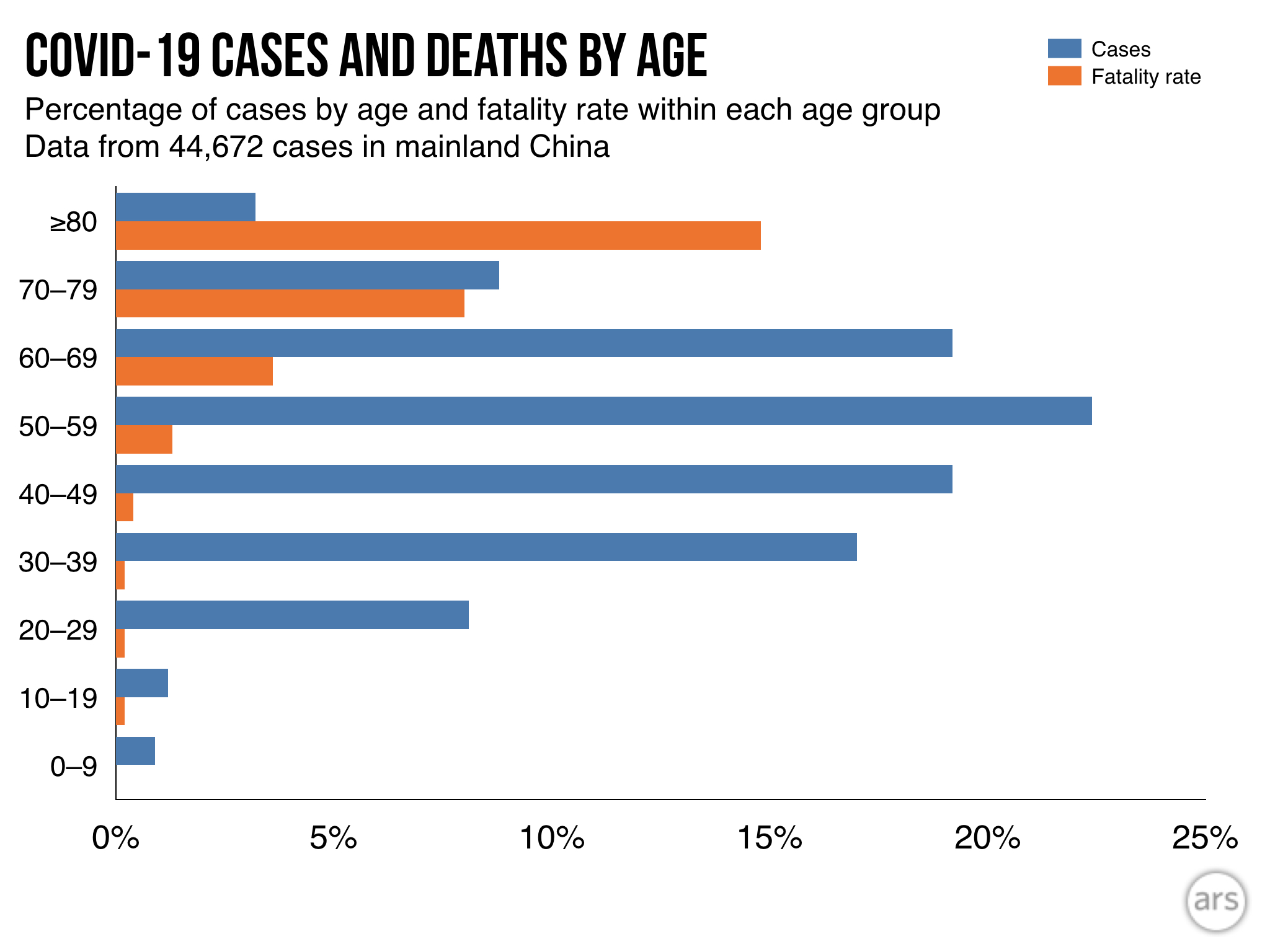
The fatality charges had been a lot upper some of the last five,279 sufferers who reported some underlying well being prerequisites. Those that reported heart problems had a fatality price of 10.five %. For sufferers with diabetes, the fatality price used to be 7.three %. Sufferers with persistent respiration illness had a price of 6.three %. Sufferers with hypertension had a fatality price of 6.zero % and most cancers sufferers had a price of five.6 %.
Puzzlingly, males had the next fatality price than ladies. Within the learn about, 2.eight % of grownup male sufferers died in comparison with a 1.7 % fatality price amongst feminine sufferers.
Are males extra in danger?
In a couple of research, researchers have famous upper case numbers in males than in ladies. The WHO Joint Undertaking file discovered that males made up 51 % of instances. Some other learn about of one,099 sufferers discovered that males made up 58 % of instances.
Up to now, it’s unclear if those numbers are actual or if they’d even out if researchers checked out higher numbers of instances. It’s additionally unclear if this bias might replicate variations in publicity charges, underlying well being prerequisites, or smoking charges that can make males extra vulnerable.
That stated, intercourse variations were noticed in diseases led to through SARS-CoV-2’s family members, SARS-CoV and MERS-CoV. There’s some initial analysis taking a look into this in mice. Some findings counsel that there is also a protecting impact from the process of the feminine hormone estrogen. Different analysis has additionally advised that genes discovered at the X chromosome which can be eager about modulating immune responses to viruses might also serve to higher give protection to genetically feminine folks, who’ve two X chromosomes, in comparison with genetic men, who’ve just one X chromosome.
Are youngsters much less in danger?
Sure, it seems that so. In all the research and information thus far, youngsters make up tiny fractions of the instances and feature only a few reported deaths. Within the 44,672 instances tested through the Chinese language CDC, lower than one % had been in youngsters ages zero to nine years previous. None of the ones instances used to be deadly. Equivalent findings were reported in different research.
The WHO-China Joint Undertaking file additionally famous that kids seem in large part unscathed on this epidemic, writing, “illness in youngsters seems to be slightly uncommon and delicate.” From the information thus far, they file that “inflamed youngsters have in large part been recognized via touch tracing in families of adults.”
An unpublished, un-peer-reviewed learn about of 391 instances in Shenzhen, China, turns out to enhance that remark. It famous that inside families, youngsters gave the impression simply as prone to get inflamed as adults, however that they had milder instances. The learn about used to be posted March four on a scientific preprint server.
Nonetheless, because the Joint Undertaking file famous, given the information to be had, it isn’t imaginable to decide the level of an infection amongst youngsters and what function that performs in using the unfold of illness and the epidemic general. “Of notice,” the file went on, “folks interviewed through the Joint Undertaking Staff may just now not recall episodes by which transmission passed off from a kid to an grownup.”
How lengthy does COVID-19 final?
On moderate, it takes 5 to 6 days from the day you might be inflamed with SARS-CoV-2 till you increase signs of COVID-19. This pre-symptomatic length—sometimes called “incubation”—can vary from one to 14 days.
From there, the ones with gentle illness generally tend to get better in about two weeks, whilst the ones with extra critical instances can take 3 to 6 weeks to get better, in step with WHO Director-Normal Dr. Tedros Adhanom Ghebreyesus, who is going through Dr. Tedros.
What number of people die from the an infection?
This can be a tough query to respond to. The secret’s that we don’t actually know.
Case fatality charges (CFR)—this is, the collection of inflamed individuals who will die from the an infection—are merely calculated through dividing the collection of lifeless through the collection of recovered plus lifeless. The CFRs you’ve most definitely noticed thus far have most likely been a crude model of this: deaths divided through general instances.
One drawback with those crude calculations is that the instances we’re counting aren’t all resolved. One of the vital sufferers who’re recently ill might later move directly to die. In that scenario, the sufferers’ instances are counted, however their deaths don’t seem to be (but). This skews the present calculation to make the CFR glance artificially low.
However a far higher worry is that we’re undercounting the collection of instances general. As a result of many of the COVID-19 instances that we find out about are gentle, well being professionals suspect that many extra inflamed folks have now not offered themselves to healthcare suppliers to be examined. They will have unsuitable their COVID-19 case for a not unusual chilly or didn’t understand it in any respect. In spaces exhausting hit through COVID-19, there won’t were sufficient checking out capability to discover all the gentle instances. If a lot of gentle instances are being overlooked within the general case rely, it might make the CFR glance artificially top.
One of the best ways to transparent up this uncertainty is to attend till one of the most native outbreaks is totally over after which to do blood assessments at the common inhabitants to look what number of people had been inflamed. The ones blood assessments would search for antibodies that focus on SARS-CoV-2. (Antibodies are Y-shaped proteins that the immune machine makes to assist determine and assault pathogens and different unfriendly invaders.) The presence of antibodies in opposition to a selected germ in an individual’s blood signifies that the individual has been uncovered to that germ, both via an infection or immunization. Screening the overall inhabitants for SARS-CoV-2 antibodies will give a clearer image of what number of people had been in fact inflamed—without reference to whether or not they had been symptomatic or recognized whilst ill. That quantity can then be used to calculate a correct CFR.
Up to now, some initial inhabitants screening for COVID-19 infections has been finished in China, particularly in Guangdong province. Screening of 320,000 individuals who went to a fever health center advised that we might not be lacking an unlimited collection of gentle instances. This in flip means that the CFRs we’re calculating now don’t seem to be wildly upper than they will have to be. Then again, professionals nonetheless suspect that many gentle instances are going unreported, and lots of nonetheless look ahead to that the actual CFR might be not up to what we’re calculating now.
Past getting the elemental collection of instances and deaths proper, CFRs also are tough as a result of they are able to range through inhabitants, time, and position. We’ve already famous above that the CFR will increase in affected person populations in line with age, gender, and underlying well being. However as time is going on, healthcare suppliers gets jointly higher at figuring out and treating sufferers, thereby decreasing the CFR.
Complicating those statistics additional, the standard of healthcare differs from position to put. The CFR in a resource-poor medical institution is also upper than that during a resource-rich medical institution. Moreover, well being programs beaten in an epidemic won’t be capable of supply optimum handle each and every affected person, artificially expanding the CFR in the ones puts.
This appears to be what we’ve noticed in China thus far. Within the WHO-China Joint Undertaking file, the professionals famous that during Wuhan—the place the outbreak started and the place well being programs were beaten through the collection of instances—the CFR used to be a whopping five.eight %. The remainder of China on the time had a CFR of zero.7 %.
As of March five, there have been about 13,000 instances and 400 deaths reported out of doors of China’s Hubei Province (the place Wuhan is positioned). A crude calculation places the CFR round three %, however this calculation will most likely float all through the outbreak. We can replace the present crude CFR periodically.


